
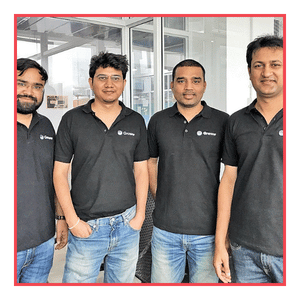
Ishan Bansal, Lalit Keshre, Neeraj Singh, Harsh Jain
Startup of the Year – Groww
Nine years ago, four former Flipkart colleagues bet that investing in India could be made as simple as shopping online. That bet has paid off spectacularly. Founded by Lalit Keshre, Harsh Jain, Neeraj Singh, and Ishan Bansal, Groww grew from a mutual funds app into the country’s largest stockbroking platform by user base, overtaking established rivals along the way. In November 2025, the company delivered one of the year’s most closely watched IPOs, and its momentum has only accelerated since — profits nearly tripled through the fiscal year and kept climbing even as rivals struggled with a broader slowdown in retail trading. With registered customers across virtually every postal code in the country, Groww has shown that scale and discipline can go together, a rare feat that made it the jury’s clear pick for Startup of the Year.

Manu Chandra
Midas Touch – Manu Chandra
A former investor at private equity firm 3i, Manu Chandra struck out on his own in 2019, launching Sauce with a modest Rs 60-crore fund and a thesis built around early, high-conviction bets on consumer brands. That thesis has since been vindicated many times over. Chandra was among the first institutional backers of names like The Whole Truth, Mokobara and Innovist, writing small early cheques and doubling down as winners emerged. This past year, Sauce’s sale of Innovist to L’Oréal became the biggest consumer-sector exit of the year, delivering an 8-10x return and cementing Chandra’s reputation as the investor founders turn to for their very first institutional cheque. The jury’s decision recognised not just the scale of the exit but the discipline of a strategy built entirely around Chandra’s own conviction.

Pallavi Mohadikar and Pallavi Shrivastava
Woman Ahead – Pallavi Mohadikar (Palmonas) and Pallavi Shrivastava (Progcap)
Two founders, two very different businesses, one shared recognition. Pallavi Mohadikar built her first company, the digital sari brand Karagiri, from the ground up before its acquisition by Mensa Brands in 2021 — and rather than pause, she turned straight to her next idea. Palmonas, the demi-fine jewellery label she co-founded in 2022, reimagined how Indian consumers think about everyday jewellery, replacing gold-locker sentimentality with skin-safe, durable pieces designed to be worn daily, and has scaled into one of the category’s defining brands. Pallavi Shrivastava took a different path: after 15 years in SME financing at the International Finance Corporation and the World Bank, she co-founded Progcap to close the credit gap for India’s underserved small retailers, building a data-driven lending platform now trusted across supply chains nationwide. Between them, the two Pallavis capture the range of what women-led entrepreneurship in India looks like today — from consumer branding to financial infrastructure.
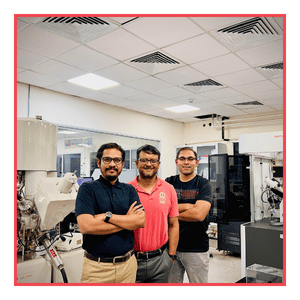
Peddi Shanmukh Srinivas, Ambarish Ghosh, Debayan Dasgupta
Top Innovator – Theranautilus
Few startups can claim to be building medicine at the scale of a bacterium, but that is precisely the frontier Theranautilus occupies. Spun out of the Indian Institute of Science, Bengaluru, by physicist Ambarish Ghosh, Peddi Shanmukh Srinivas along with Debayan Dasgupta has spent years engineering magnetically steerable nanorobots capable of navigating deep inside the body to reach sites conventional treatment cannot. Its first application targets one of dentistry’s most persistent failures — root canal infections that resist standard treatment in millions of cases worldwide. By guiding nanobots directly into infected dentinal tubules and remotely activating them to clear bacteria, Theranautilus is turning a decades-old physics research problem into a deployable medical device. The recognition reflects the jury’s conviction that India’s deep-tech research base, when paired with founders willing to commercialise it, can produce genuinely novel healthcare innovation.

Saurabh Bothra, Trishala Bothra, Anshul Agrawal
Bootstrap Champ – Habuild
Chakr Innovation, founded at IIT-Delhi in 2016 by Kushagra Srivastava, is tackling one of India’s most pressing urban problems, air pollution. Its breakthrough device, Chakr Shield, retrofits diesel generators to cut particulate emissions by up to 70%, while converting captured soot into usable carbon black. Already deployed across thousands of sites for 1,500 clients, Chakr has turned regulatory compliance into a climate-tech opportunity. With FY24 revenues crossing ₹125 crore and profitable growth, the company is now expanding its technology to vehicles and other stationary sources, proving that clean air can go hand in hand with sustainable business.
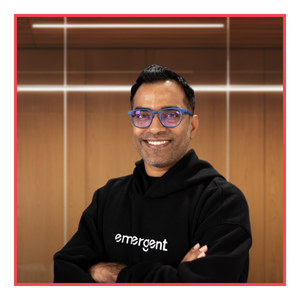
Mukund Jha
Comeback Kid – Emergent
Mukund Jha has built and lost before. A cofounder and CTO of Dunzo, and earlier of the video-meetup startup Wisdom.ly, Jha stepped away from a PhD to chase entrepreneurship, then watched ventures rise and stall before finding his footing again. In 2024, he teamed up with his twin brother Madhav to found Emergent, an AI platform that lets anyone build production-ready software by describing what they want in plain language. The bet on democratising software creation proved prescient — within seven months of public launch, Emergent had crossed $50 million in annual recurring revenue, drawn more than 5 million users across 190 countries, and raised over $100 million from investors including Khosla Ventures and SoftBank. For a founder who had weathered false starts before, this comeback arrived not incrementally, but at extraordinary speed.

Vishrant Dave, Prateesh Awasthi, Ayush Ranjan
Best on Campus – Armatrix
What began as a student project inspired by the International Space Station’s robotic arm has become one of India’s most closely watched deeptech startups. Vishrant Dave, Ayush Ranjan, and Prateesh Awasthi, all IIT Kanpur graduates, founded Armatrix in 2024 to build hyper-redundant, snake-like robotic arms capable of slithering into confined, hazardous industrial spaces that no human should have to enter. Spanning three to five metres with more than 22 degrees of freedom, the robots are designed for inspection and maintenance work in shipyards, refineries, and defence sites — sectors where downtime and safety risk both carry a steep cost. The founders’ campus-born research, once recognised on the global stage at the International Astronautical Congress, has since translated into $2.1 million in pre-seed funding and a working proof-of-concept, marking Armatrix as one of only a handful of companies worldwide attempting this category of robotics.

Vishal Kuchanur, Ankita Garg, Madhur Jain
Social Enterprise – Varaha
Prukalpa Sankar, co-founder and CEO of Atlan, represents a new generation of global SaaS leaders from India. Atlan, her second venture after SocialCops, has become the go-to data collaboration platform for enterprises worldwide, integrating seamlessly into the modern data stack. In 2024, the company raised $105 million led by GIC and Meritech, pushing its valuation to $750 million. Sankar’s leadership blends sharp product thinking with a community-first culture, helping Atlan expand rapidly in the US while staying anchored in its mission, making data more human. Her journey is a testament to how Indian entrepreneurs are now shaping category-defining software for the world.